
Postcode districts – the broader “neighbourhood” portion of a full postcode – e.g. NW10 or IV7 or ZE2 – are the part of the postcode that comes before the space. Insurance companies love them but there are lots of caveats.
First of all, to get an idea of scale, there are around 3,000 postcode districts across the UK, compared to about 1.7 million postcode units.
You could just compare them by total crime count and using UKCrimeStats Postcode District Page, you would see something like this;
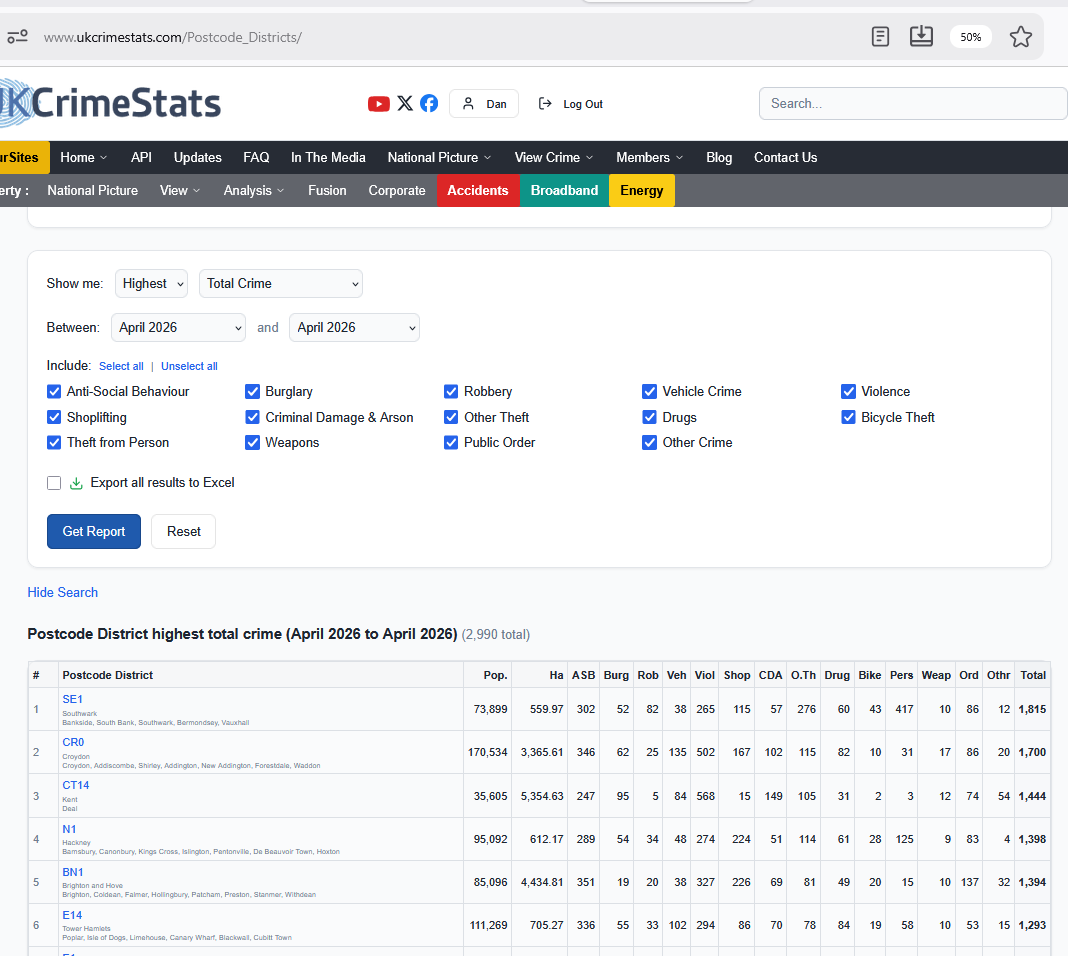
But just comparing crime counts doesn’t work because they are emphatically not the same on several levels and you would not be comparing like with like.
Take size for example. The largest postcode district is LD3 in Wales which is a staggering 851,000 hectares. And one of the smallest is BT1 in Belfast with just 151 hectares – about 2 square kilometres. So how do you compare such diverse sizes on a like for like basis?
The answer is to use crimes per hectare – a unique feature available to subscribed members of UKCrimeStats.com – and your top results would look like this;
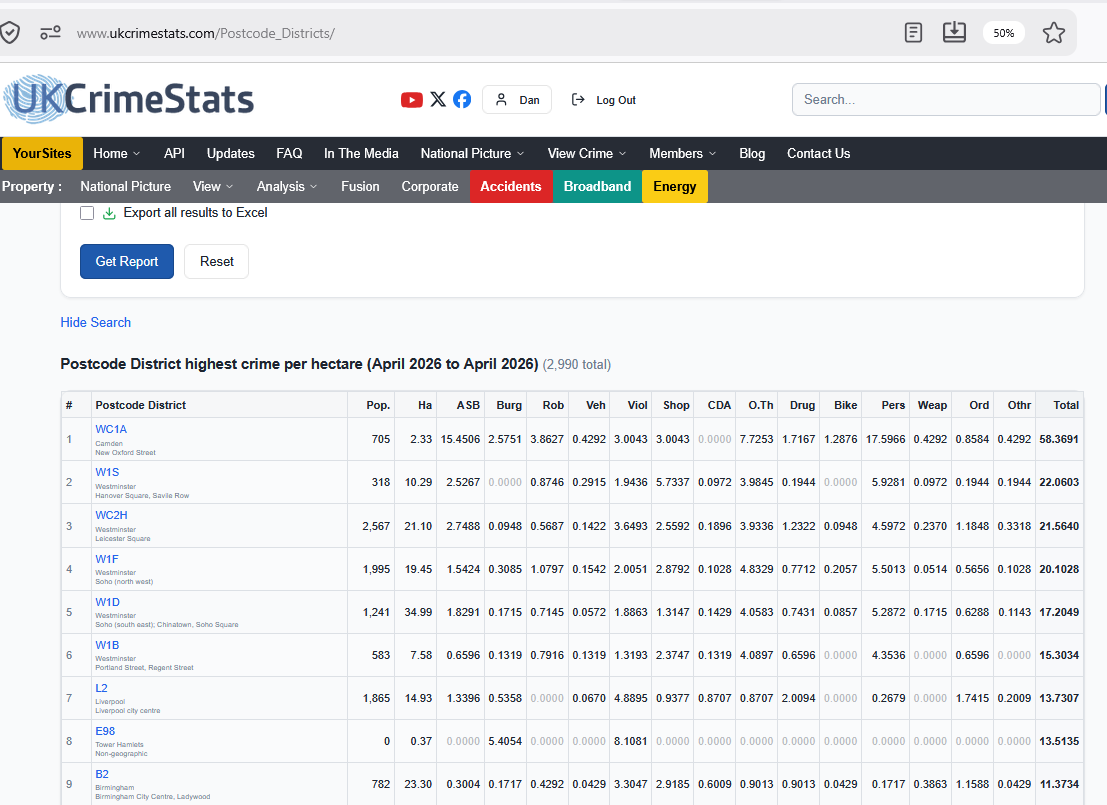
Basically, a lot of small postcode districts with very high population counts in city centres.
Ok you say, but what about population?
The more people you have, the more likely you are to have crime as victims and perpetrators are more likely to cross paths. To state the obvious, you can’t really have crime in an area with no people. Although you can have crime against inanimate objects – like damage to cars or houses – rather than people.
The highest – residential – population postcode district is CR0 in Croydon, outer London with 170,000 people. As someone who grew up in that area, I can tell you there’s a huge difference between the best and worst areas of Croydon and to blanket them all together as insurance companies often do, has often caused local protest.
The smallest – more or less – populated postcode district is CM99 in Chelmsford with just 1 person.
So how do you compare different postcode districts with wildly different sized populations? The answer is to use crime rate – the number of crimes per 1,000 residents. This equalizes/allows for the difference in population.
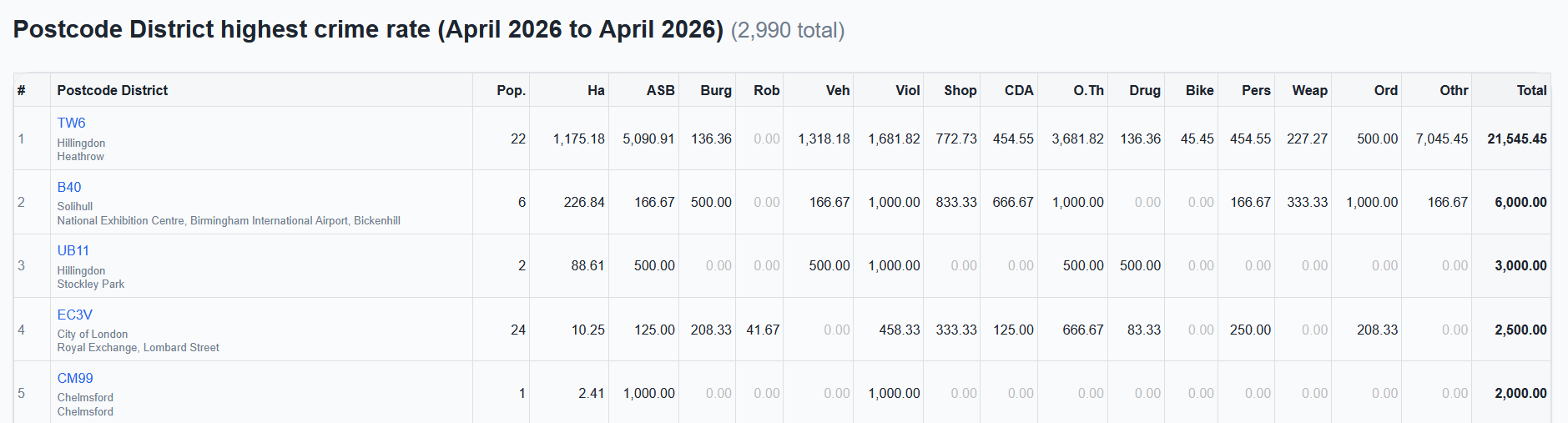
Even then, that’s not the whole story on population. Some areas, e.g. central London, may actually have a daytime population up to ten times higher than the residential one. This inevitably leads to much higher crime in central London in aggregate but it appears to feel safe, because numbers of overall people are also much higher. Safety in numbers, as it were.
So divergent size, population, residential and daytime make comparing postcode districts hard. The best way to account for that is by measuring by crime rate and by crimes per hectare – which you can easily do with a membership to UKCrimeStats.com – just sign up here.